Wheat flour is one of the most widely used food ingredients in the world. From bread and noodles to biscuits, pasta, snacks, and industrial food production, many sectors depend on a stable supply of flour with consistent quality.
For this reason, wheat flour milling plants are not limited to traditional flour mills. They support a much broader network of food processors, agricultural companies, grain distributors, commercial bakeries, and industrial food manufacturers.
For investors or companies planning to install a wheat flour milling plant, understanding the main downstream industries is important. The intended application influences flour specifications, milling capacity, equipment configuration, automation level, packaging system, and even the type of wheat that should be processed.
This article explains which industries use wheat flour milling plants the most and what each sector typically requires from a flour milling operation.
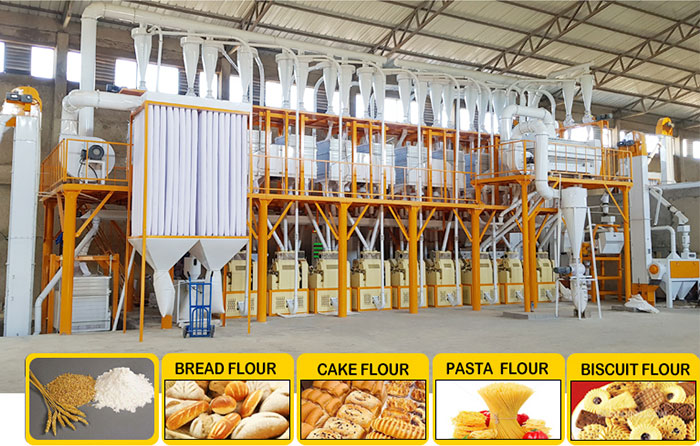
The most direct users of wheat flour milling plants are commercial flour producers.
These companies purchase wheat in bulk, process it into different grades of flour, and then supply the flour to bakeries, food factories, wholesalers, supermarkets, restaurants, and institutional buyers.
Depending on market demand, a commercial flour mill may produce:
All-purpose flour
Bread flour
Cake flour
Pastry flour
Whole wheat flour
High-gluten flour
Low-gluten flour
Semolina or specialty wheat products
Commercial flour mills usually require relatively high production capacity because they serve multiple customer groups.
A complete industrial wheat flour milling line may therefore include:
Wheat receiving systems
Grain storage silos
Cleaning equipment
Stone removal equipment
Magnetic separation
Wheat conditioning
Roller milling
Plansifting
Purification
Flour blending
Flour storage
Automatic weighing
Bagging and packaging
For commercial flour manufacturers, production stability and flour consistency are especially important because downstream customers expect every batch to perform similarly.
The bakery industry is one of the largest consumers of wheat flour.
Large bakeries producing bread, buns, rolls, toast, cakes, pastries, pizza bases, and other baked foods consume substantial quantities of flour every day.
Some large bakery groups choose to operate their own flour milling facilities rather than depending entirely on external suppliers.
This allows them to have better control over:
Flour protein content
Gluten strength
Ash content
Moisture level
Particle size
Dough performance
Flour freshness
Raw material costs
For example, industrial bread production normally requires flour with sufficient gluten strength to maintain dough structure during mixing, fermentation, proofing, and baking.
Cake manufacturers, however, may prefer softer wheat flour with lower protein levels.
Therefore, a wheat flour milling plant serving bakery applications should often be able to produce different flour grades through controlled milling and flour blending.
Noodles are a major wheat-based food product in many markets, particularly across Asia, the Middle East, and increasingly in international processed-food markets.
Wheat flour is widely used for manufacturing:
Instant noodles
Fresh noodles
Dried noodles
Hand-pulled noodles
Egg noodles
Ramen
Udon-style noodles
Dumpling wrappers
Wonton wrappers
Noodle manufacturers usually pay close attention to flour characteristics such as:
Protein content
Dough elasticity
Gluten quality
Flour color
Water absorption
Particle uniformity
Ash content
A flour milling plant supplying noodle manufacturers therefore needs precise control over the milling process.
Consistent flour quality is particularly important for automated noodle production lines because variation in flour performance may affect dough mixing, sheeting, cutting, drying, and final noodle texture.
Biscuit, cracker, and cookie factories represent another important market for wheat flour.
Unlike bread production, many biscuit products require relatively low-gluten flour.
Too much gluten development can make biscuits harder or change their desired texture.
Manufacturers may use wheat flour for products such as:
Cookies
Sweet biscuits
Crackers
Sandwich biscuits
Wafer products
Shortbread
Digestive biscuits
Savory snacks
Flour mills serving this industry may therefore focus on producing softer, lower-protein flour with tightly controlled particle size.
Large biscuit factories often purchase flour in bulk, which creates steady demand for high-capacity commercial wheat flour milling plants.
Pasta production also relies heavily on wheat milling.
Depending on the region and product, manufacturers may use durum wheat semolina, hard wheat flour, or specific blends.
Common pasta products include:
Spaghetti
Macaroni
Penne
Lasagna
Fusilli
Vermicelli
Couscous
Specialty pasta
Pasta manufacturers generally require flour or semolina with good protein quality, suitable granulation, and stable color.
For flour mill operators supplying pasta factories, the milling process must be designed according to the intended wheat variety and final product specification.
This is important because the milling process for durum wheat products may differ from conventional bread flour production.
Many snack manufacturers also depend on wheat flour as either a primary ingredient or functional component.
Examples include:
Extruded snacks
Coated snacks
Crackers
Fried dough products
Savory biscuits
Filled snacks
Breaded products
Wheat-based chips
Large snack factories normally require consistent raw materials because their production lines operate continuously at high speeds.
A flour supplier that cannot maintain stable moisture, protein, particle size, or baking performance may create production problems for these factories.
Consequently, flour mills serving industrial snack manufacturers often emphasize process control, laboratory testing, and standardized flour blending.
The frozen food sector uses significant quantities of wheat flour.
Common applications include:
Frozen pizza
Dumplings
Frozen bread
Frozen pastries
Frozen pancakes
Pie crusts
Frozen dough
Breaded meat or seafood products
Frozen food manufacturers often have specific requirements for flour performance because freezing and thawing can affect dough structure.
For example, frozen dough may require flour with suitable gluten strength to maintain texture after storage and thawing.
Suppliers serving this market therefore need reliable flour specifications and consistent production.
Many general food-processing companies use flour even when wheat flour is not the main ingredient in the finished product.
Flour may function as:
A thickening ingredient
A coating material
A binding ingredient
A dough-forming ingredient
A texture modifier
A carrier for seasoning
A base ingredient for premixes
Examples include manufacturers of:
Sauces
Soups
Ready meals
Breaded foods
Prepared meat products
Frozen foods
Seasoning mixes
Large food processors may purchase hundreds or thousands of tons of flour annually.
This creates opportunities for commercial flour mills located close to major food-processing clusters.
Bakery premix manufacturers combine flour with other ingredients to produce standardized mixes.
Typical products include:
Bread mixes
Cake mixes
Pancake mixes
Waffle mixes
Pizza dough mixes
Muffin mixes
Cookie mixes
For these manufacturers, ingredient consistency is extremely important.
If the flour changes significantly between batches, the final premix may behave differently for customers.
Flour mills supplying premix factories therefore need strong quality-control procedures and accurate flour blending capabilities.
Restaurants typically do not operate their own wheat flour milling plants. However, the foodservice industry creates substantial downstream demand for flour.
Flour is widely used by:
Pizza restaurants
Bakeries
Hotels
Cafés
Catering companies
Fast-food chains
Noodle restaurants
Central kitchens
Large foodservice distributors supply flour to thousands of these customers.
As a result, commercial flour milling companies often develop dedicated flour products for the foodservice market.
Common packaging sizes may include:
10 kg bags
20 kg bags
25 kg bags
50 kg bags
Bulk flour delivery
The appropriate packaging system therefore becomes an important consideration when configuring a wheat flour milling plant.
Some agricultural companies and grain traders expand into flour milling to increase the value of wheat before selling it.
Instead of selling raw wheat directly, they process it into higher-value products such as flour, bran, and other milling by-products.
This type of vertical integration can offer several advantages.
Companies can process their own grain instead of selling everything as raw agricultural commodities.
Flour generally provides more opportunities for branding, packaging, and distribution than unprocessed wheat.
Wheat milling produces valuable by-products such as bran, which can be sold to animal-feed manufacturers.
For this reason, wheat-producing regions often attract investment in medium and large flour milling plants.
Although flour is primarily produced for human consumption, wheat milling by-products are widely used in animal feed.
Typical by-products include:
Wheat bran
Wheat shorts
Wheat middlings
Broken grain
Milling residues suitable for feed
These materials can be used in feeds for:
Cattle
Poultry
Pigs
Sheep
Other livestock
This means a wheat flour milling plant may serve both the food and feed industries.
Efficient by-product collection and storage can significantly improve the overall economics of a flour milling project.
In some countries, wheat flour milling plants are developed as part of national or regional food-security programs.
Governments, agricultural cooperatives, and development organizations may invest in local flour production to:
Reduce dependence on imported flour
Process locally grown wheat
Improve food availability
Create employment
Support agricultural development
Stabilize flour supply
Strengthen regional food-processing capacity
These projects may range from smaller regional mills to large industrial flour milling complexes.
Reliability, ease of maintenance, local spare-parts support, and operator training often become especially important when selecting equipment for these projects.
The required wheat flour milling plant capacity depends heavily on the target customer base.
A small local flour producer may operate with relatively modest daily output, while a large industrial flour company may process hundreds or even thousands of tons of wheat per day.
A simplified comparison can look like this:
| Industry | Typical Flour Demand | Important Requirements |
|---|---|---|
| Commercial flour mills | Very high | Multiple flour grades, automation, high throughput |
| Industrial bakeries | High | Protein consistency, gluten performance |
| Noodle factories | High | Dough elasticity, flour color, particle consistency |
| Biscuit manufacturers | Medium to high | Low-gluten flour, controlled particle size |
| Pasta factories | High | Suitable wheat type, protein quality, granulation |
| Snack factories | Medium to high | Stable processing characteristics |
| Frozen food factories | Medium to high | Dough stability and consistent flour quality |
| Premix manufacturers | Medium | Precise specifications and batch consistency |
| Foodservice distributors | High | Flexible packaging and reliable supply |
| Grain companies | Medium to very high | Efficient wheat utilization and multiple products |
Different industries require different flour characteristics. Therefore, buyers should define the final product before selecting milling equipment.
Several factors should be considered.
Determine how many tons of wheat must be processed within 24 hours.
The plant should have enough capacity for both current demand and expected business growth.
Decide whether the plant will primarily produce:
Bread flour
All-purpose flour
Cake flour
Biscuit flour
Noodle flour
Whole wheat flour
Specialty flour
The product mix influences the milling process and equipment configuration.
Hard wheat, soft wheat, and durum wheat have different milling requirements.
The plant design should match the available raw wheat.
A good milling system should balance flour extraction rate with required flour quality.
Simply maximizing extraction is not always the best approach because different flour grades have different ash and quality requirements.
Larger industrial plants normally benefit from automated:
Feeding
Conveying
Milling
Sifting
Flour blending
Weighing
Packaging
Process monitoring
Automation helps reduce labor dependence and improve production consistency.
Flour milling involves multiple machines operating continuously.
Energy-efficient motors, optimized conveying systems, and properly designed processing flows can reduce operating costs.
Equipment used for flour production should be designed for easy cleaning and hygienic operation.
Dust control is also important because wheat cleaning, grinding, and flour conveying can generate significant airborne particles.
A flour mill often operates continuously.
Reliable technical support, accessible spare parts, and easy maintenance can therefore be just as important as the initial equipment price.
There is no single wheat flour milling plant configuration suitable for every application.
A mill supplying local retail flour may prioritize flexible packaging and multiple flour grades.
A plant serving large industrial bakeries may prioritize stable bread flour quality and bulk flour delivery.
A noodle flour supplier may require tighter control over ash content, color, and gluten properties.
A large agricultural company may focus on high-capacity wheat handling, silo integration, and automated continuous production.
Therefore, an effective flour mill design should begin with the final market rather than simply selecting machines based on capacity.
The industries that use wheat flour milling plants most heavily include commercial flour production, industrial bakeries, noodle manufacturing, biscuit and cookie production, pasta processing, snack manufacturing, frozen food production, and general food processing.
Agricultural companies, grain traders, animal-feed manufacturers, foodservice suppliers, and government food-security projects also create significant demand for wheat milling capacity.
For investors, flour manufacturers, or food-processing companies planning a new milling project, the most important step is to first identify the intended flour market.
Once the required flour type, production capacity, wheat characteristics, automation level, and packaging method are clear, the wheat flour milling plant can be configured to deliver more consistent quality, efficient production, and better long-term operating economics.
Commercial bakeries, noodle manufacturers, biscuit factories, pasta producers, snack manufacturers, and other industrial food processors are among the largest consumers of wheat flour.
Yes. A properly designed milling plant can separate different flour streams and blend them according to specific quality requirements, allowing manufacturers to produce multiple flour grades.
Capacity should be determined according to expected wheat availability, flour demand, operating hours, target market, storage capacity, and future expansion plans.
Yes. Many commercial flour mills supply large bakeries directly. Depending on production scale, flour can be delivered in bags or through bulk flour handling systems.
Wheat bran, wheat shorts, middlings, and other milling fractions are common by-products. Many of these materials can be sold to animal-feed manufacturers.
Automated baking and food-processing lines require predictable dough and processing behavior. Variations in protein, moisture, ash, or particle size can affect production efficiency and finished-product quality.
It depends on production capacity. Smaller mills can operate with partial automation, while medium and large industrial plants usually benefit from automated control, conveying, weighing, blending, and packaging systems.

Copyright © Hebei Pingle Grain Technology Intelligent Equipment Co.ltd. All Rights Reserved | Sitemap | Technical Support: 

 English
 русский
 فارسی
فارسی Português
 français
 عربى
عربى España