Corn processing equipment can transform raw maize into various finished products such as corn bran, corn grits, and corn flour. These machines are widely used in grain processing industries and can meet different production requirements.
Setting up a maize flour milling plant is a profitable venture in many countries such as Kenya, Zambia, Tanzania, Uganda, and Nigeria. Whether you are familiar with maize processing or completely new to this field, understanding the full production process and the components of a complete maize flour milling line is essential. These factors directly influence the efficiency, stability, and success of a maize flour business.
Start Maize Flour Milling Business
For most investors, farmers, and small-scale entrepreneurs, compact maize flour milling machines that include every step of the production process are often the most practical option. These units offer commercial-quality output with a much lower investment threshold and easier maintenance requirements.
This complete processing line is designed according to market demand and global trends in the maize milling industry. Although compact, it incorporates the core functions of a large-scale maize processing plant.
From raw grain elevation, air selection, removal of micro-impurities, stones and metals, moisture adjustment, peeling, germ separation, crushing, sifting, fine milling, to packaging—every stage of the maize flour production process is included.
The system can produce different sizes of maize grits and corn flour ranging from 30 to 120 mesh, meeting various consumption and market needs.
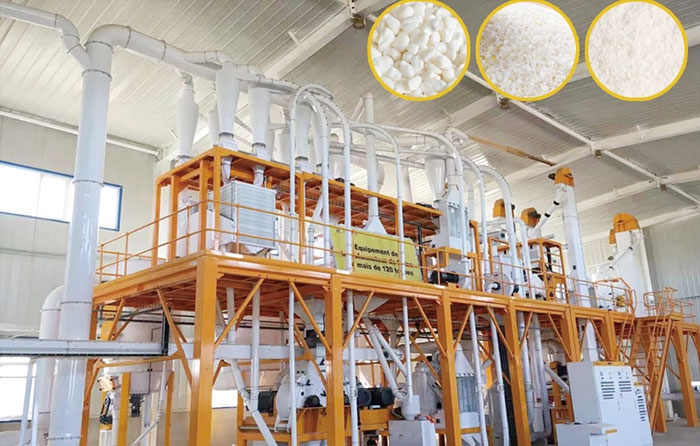
There is also a newer type of maize flour processing line designed for higher automation, dry peeling, and compatibility with multiple grains. It has become increasingly popular due to the following advantages:
Small Maize Flour Production Plant
Mini Maize Flour Mill Plant
Low power consumption, high efficiency, simple operation, and easy maintenance
Streamlined modular design integrating grain cleaning, double peeling, and a polishing process to achieve fully automated production
A dry peeling method that avoids water contact, ensuring cleaner, more sanitary processing conditions
Flexible structure capable of milling other grains such as wheat, sorghum, millet, and more
Key components made from high-strength alloy materials that comply with export standards, ensuring long-term durability and stable operation
Total investment for the same capacity is over 50% lower than typical domestic models and about 80% lower than comparable international equipment
Automated workflow requires only one operator for electronic control and one worker for packing, significantly reducing labor costs
Equipment used in this processing line has been successfully applied and validated in the market for more than 20 years, earning strong trust from users in multiple countries
Professional suppliers can provide complete services including equipment selection, workshop layout design, installation, commissioning, technical training, and overall project planning. Because the core equipment is self-manufactured, factory-direct pricing can be offered along with detailed equipment lists, production line specifications, and project cost estimates.
The maize flour milling process consists of several mechanical steps. It starts with cleaning and ends with grinding and sieving to obtain the desired type of flour.
1. Cleaning
The first stage of maize flour production is cleaning, which removes foreign materials such as dirt, sand, stones, plant debris, and metal fragments. These impurities can affect the quality of the final flour or cause damage to the milling equipment.
Different sieving and screening machines are used to separate particles that are larger or smaller than the maize kernels. Proper cleaning ensures that only high-quality raw grain enters the next stage of processing, providing a strong foundation for premium flour output.
2. Conditioning
After cleaning, the maize is conditioned by adding controlled amounts of moisture and allowing the kernels to rest for a specific period. This helps loosen the outer bran layer, making peeling more efficient.
The maize is then de-germinated and polished, separating the germ, endosperm, and bran. Proper separation is essential for high-quality flour because grinding these components together can cause:
Reduced shelf life due to higher oil content from the germ
A yellowish color in cooked products
Poorer taste and texture
Digestive discomfort such as bloating
Conditioning ensures a clean separation of components, resulting in a finer, higher-grade flour.
3. Milling
Once peeled and de-germed, the maize enters the milling section, where it is ground into flour. After grinding, the flour is sieved to classify it into different grades. Flour that meets the required fineness is collected as the finished product, while coarser material is returned for further milling.
This repeated cycle helps achieve uniform particle size and higher extraction rates, ensuring consistent quality across all batches of production.

Establishing a maize flour milling operation—whether small-scale or more advanced—requires a solid understanding of both the processing equipment and the production workflow. From cleaning and conditioning to peeling, de-germination, grinding, and final sieving, each stage plays a crucial role in determining the quality, yield, and market value of the finished maize products.
Modern small and medium-sized processing lines provide a practical solution for investors and entrepreneurs by offering high efficiency, streamlined operation, reduced labor requirements, and the flexibility to produce different grades of maize grits and flour. With well-designed modular systems, cleaner dry-peeling technology, and durable components, these plants deliver stable performance while significantly lowering overall investment costs.
For anyone planning to enter the maize processing industry, choosing reliable equipment, designing an efficient production layout, and understanding the full milling process are essential steps toward building a sustainable and profitable maize flour business.
Copyright © Hebei Pingle Grain Technology Intelligent Equipment Co.ltd. All Rights Reserved | Sitemap | Technical Support: 

 English
 русский
 فارسی
فارسی Português
 français
 عربى
عربى España