Choosing the right maize flour milling plant capacity is one of the most critical decisions for investors, mill owners, and food processing companies. An oversized plant increases capital and operating costs, while an undersized system limits output, profitability, and market growth. This guide walks you through the key factors that help determine the optimal capacity for your maize flour milling project.
The first step is to clearly define who you are producing for and how much maize flour the market can absorb.
Ask yourself:
Are you supplying local retail markets, wholesalers, or industrial buyers?
Is demand stable year-round or growing rapidly?
Are you targeting human food, animal feed, or both?
For example:
Small local markets may only require 10–30 tons/day
Regional distributors often need 50–100 tons/day
Export-oriented or national brands usually operate 100+ tons/day
Your plant capacity should align with realistic sales volume, not optimistic projections.
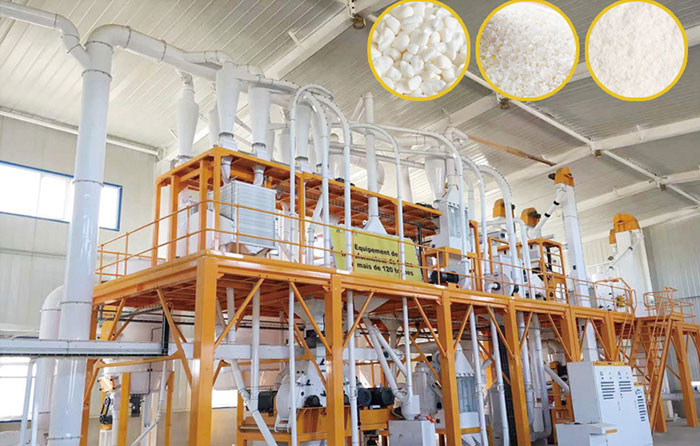
A maize flour milling plant can only run efficiently if there is a stable and sufficient maize supply.
Key considerations:
Local maize production volume
Seasonal availability and storage capability
Moisture content and grain quality
Price volatility during off-seasons
If raw maize supply is inconsistent, a moderate-capacity plant with expansion potential is often safer than a large fixed-capacity installation.
Plant capacity directly affects capital expenditure (CAPEX) and operating costs (OPEX).
Higher-capacity plants require:
Larger buildings and foundations
Higher power consumption
More skilled operators
Higher maintenance costs
However, they usually offer:
Lower cost per ton
Better automation
Higher long-term profitability
A practical approach is to calculate:
Cost per ton of flour produced
Expected payback period
Break-even production volume
For first-time investors, starting with a mid-capacity plant (30–60 tons/day) often balances risk and return.
Different maize flour products require different processing intensity, which impacts capacity.
Capacity selection should reflect:
Whole maize flour vs degerminated flour
Fine flour vs coarse meal
Fortified or specialty flour requirements
Plants producing high-quality, food-grade maize flour typically operate at slightly lower effective throughput due to additional cleaning, degermination, and quality control stages.
Modern maize flour milling plants can be:
Semi-automatic
Fully automatic
A highly automated plant:
Requires fewer workers
Maintains consistent output
Operates efficiently at higher capacities
If skilled labor is limited or labor costs are rising, investing in automation-friendly capacity improves long-term sustainability.
Market demand rarely stays static. A smart capacity choice allows for future scalability.
Look for:
Modular plant design
Space for additional milling lines
Upgrade-ready control systems
Many buyers start with a 30–50 tons/day plant and expand to 100 tons/day as market share grows, avoiding early overinvestment.
Infrastructure constraints often determine realistic plant capacity:
Power supply stability
Water availability
Transport access
Local food safety regulations
In regions with limited power infrastructure, a medium-capacity energy-efficient plant performs better than a large high-load system.
Choosing the right maize flour milling plant capacity is not about buying the biggest machine—it’s about selecting a system that fits your market demand, raw material supply, budget, and growth strategy.
A well-matched capacity ensures:
Stable production
Lower operational risk
Faster return on investment
Long-term scalability
Working with an experienced milling plant supplier can help you analyze these factors and design a capacity solution tailored to your specific business goals.

Copyright © Hebei Pingle Grain Technology Intelligent Equipment Co.ltd. All Rights Reserved | Sitemap | Technical Support: 

 English
 русский
 فارسی
فارسی Português
 français
 عربى
عربى España