Reducing waste in a maize flour milling plant is not only a cost-saving strategy but also a key driver of operational efficiency, product consistency, and long-term sustainability. In modern grain processing environments, even small improvements in yield can significantly increase profitability. Waste reduction focuses on maximizing flour extraction, minimizing bran losses, optimizing energy use, and improving overall process control from intake to packaging.
Before improving efficiency, it is essential to identify the main sources of waste in a maize flour milling operation:
1. Raw Material Losses During Intake
Waste often begins at the receiving stage. Poor-quality maize, excessive moisture, or damaged grains can lead to lower extraction rates and higher rejection levels. Spillage during unloading is another common issue in less automated facilities.
2. Inefficient Cleaning and Conditioning
If cleaning systems are not properly calibrated, valuable endosperm may be removed along with impurities. Over-conditioning or under-conditioning maize can also reduce milling efficiency and increase bran contamination in the final product.
3. Milling and Grinding Inefficiencies
Incorrect roller gap settings, worn milling components, or poor equipment alignment can lead to inconsistent particle size and unnecessary flour loss in bran streams.
4. Product Loss in Sieving and Airflow Systems
Improper airflow control in aspirators or sifters can carry fine flour particles into waste streams, reducing overall yield.
5. Packaging and Handling Losses
Spillage during bagging, inaccurate weighing systems, and manual handling errors contribute to avoidable product loss.
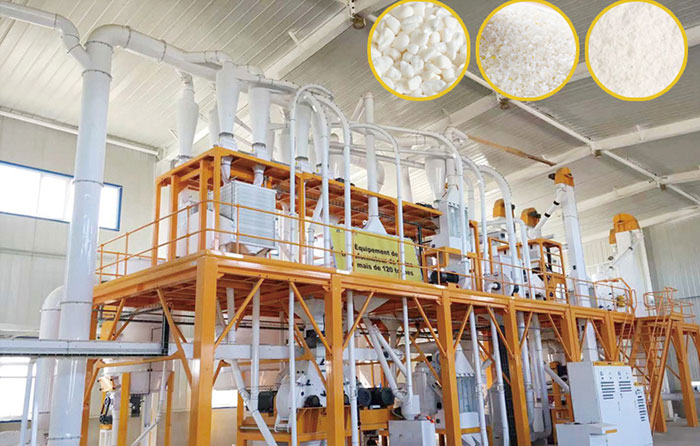
Optimize Raw Material Selection and Storage
High-quality output starts with high-quality input. Establish strict procurement standards for maize moisture content, kernel integrity, and foreign material limits. Proper silo storage with humidity and temperature control helps prevent spoilage and insect infestation, reducing downstream waste.
Improve Pre-Cleaning and Cleaning Efficiency
Modern cleaning systems using vibrating screens, destoners, magnetic separators, and air aspiration can significantly reduce impurities while preserving usable grain. Regular calibration ensures that only unwanted materials are removed.
Control Moisture Conditioning Precisely
Tempering is one of the most critical steps in maize milling. Optimized moisture levels improve endosperm separation from bran, increasing flour yield. Over-conditioning leads to sticky grinding conditions, while under-conditioning reduces extraction efficiency.
Upgrade Milling Equipment and Maintenance Practices
High-efficiency roller mills and properly aligned grinding systems reduce energy consumption and improve particle consistency. Routine maintenance of rollers, bearings, and sifters ensures stable performance and prevents unexpected downtime-related waste.
Implement Real-Time Process Monitoring
Modern milling plants increasingly rely on digital monitoring systems that track extraction rates, particle size distribution, and machine performance in real time. Early detection of deviations helps prevent large-scale material loss.
Optimize Airflow and Aspiration Systems
Proper airflow calibration ensures that flour is separated effectively without being lost into dust collection systems. Regular inspection of ducts, cyclones, and filters improves recovery rates.
Improve Packaging Accuracy and Automation
Automated weighing and bagging systems reduce human error. High-precision load cells ensure each package meets target weight without overfilling or underfilling, minimizing product giveaway.
Train Operators for Process Discipline
Even the best equipment can perform poorly without skilled operators. Training programs focusing on equipment calibration, cleaning procedures, and process control significantly reduce operational waste.
Waste in milling plants is not limited to material loss. Energy inefficiency also contributes to higher operational costs.
Use energy-efficient motors and drives
Optimize mill load distribution
Reduce idle running time of equipment
Maintain clean and efficient dust collection systems
Reducing energy waste indirectly improves overall plant productivity and lowers cost per ton of output.
Implementing a structured waste reduction strategy delivers multiple advantages:
Higher flour extraction rates from the same raw material
Lower production costs per ton
Improved product consistency and quality
Reduced environmental impact through lower by-product waste
Increased equipment lifespan due to optimized operation
Better compliance with food safety and sustainability standards
Reducing waste in a maize flour milling plant requires a holistic approach that integrates raw material control, process optimization, equipment maintenance, and operator training. By focusing on efficiency at every stage—from intake to packaging—mills can significantly increase yield while lowering costs and improving product quality.
A well-optimized milling operation does not simply produce flour; it maximizes value from every grain of maize.

Copyright © Hebei Pingle Grain Technology Intelligent Equipment Co.ltd. All Rights Reserved | Sitemap | Technical Support: 

 English
 русский
 فارسی
فارسی Português
 français
 عربى
عربى España